
Inside Pontotoc County Property Tax Records
Three offices divide the work in Pontotoc County. The Tax Assessor sets true value and maintains the assessment roll. The Tax Collector issues the bill. The Chancery Clerk holds land instruments and assists with tax-sale records. The assessor's public result is informational. The county offers no online bill or payment-status portal.
| Tax item | What it represents | Official source |
|---|---|---|
| True value | Appraisal starting point | Tax Assessor |
| Assessed value | True value times the statutory class ratio | Assessment roll |
| Millage | Local levy applied to assessed value | Current county tax materials |
| Homestead | Qualifying primary-residence relief | Tax Assessor |
| Bill and status | Amount issued, paid, due or delinquent for a year | Tax Collector |
A deed's consideration value records what a transaction stated. It is not the assessor's true value, not the assessed value, and not a current tax bill.
Mississippi Ratios Behind Pontotoc Assessments
Under Mississippi Department of Revenue tax guidance, owner-occupied single-family homes fall in Class I, assessed at 10 percent of true value. Other real property is usually Class II. Class II applies a 15 percent ratio, as does Class III personal property. Public utilities are Class IV at 30 percent. Motor vehicles fall in Class V, also at 30 percent, so the class determines the ratio each parcel or asset must carry. Same true value, different class, different assessed figure.
Tax vocabulary. True value is the appraisal base. Assessed value applies the ratio to that base. Millage is the levy charged on assessed value, while a homestead exemption adjusts qualifying tax treatment and a tax lien marks an unpaid obligation.
The state formula is true value multiplied by assessment ratio and millage. Verify the class for mixed-use, agricultural, income-producing, or unusual property rather than assuming the residential ratio applies. Real property must be revalued at least once every four years, but Pontotoc County's present cycle was not published in the reviewed sources.
The Four Fields in Pontotoc's Assessor Search
The free Pontotoc assessor search accepts four inputs: PPIN, PARID, Owner, and Address. A result can return PPIN, PARID, OWNER, ADDRESS, DEED BK, DEED PG, LEGAL 1, and Amount. Amount is not proof of a bill. Tax-amount questions go to the Tax Collector.
| Search key | Best use | Save from the result |
|---|---|---|
| Address | Known situs | PPIN, PARID, legal description |
| PPIN | Fallback for PARID formatting | Owner and deed reference |
| PARID | Assessment-to-map join | Exact spaces and suffix |
| Owner | Multiple parcels under one name | Every distinct row |
Search by address first and keep both identifiers. Then contact the collector for the requested year's issued bill and its payment status.
Request a Pontotoc County Tax Bill
Pontotoc County publishes no online tax-bill lookup. No bill-number form or payment field exists either. A complete property records check means asking the Tax Collector directly rather than reading the assessor's Amount column as a bill.
- Search the assessment roll and copy the address, PPIN, PARID, owner, and legal description.
- Identify the tax year and ask the Tax Collector at 11 E Washington Street for the bill and payment status.
- Ask whether a delinquent balance, sale, or redemption record exists.
- Cross-check a lien, sale, release, or later conveyance in the Chancery land index.
A written request works best. Name the parcel, tax year, record, and format. Ask for a fee estimate as well. The Mississippi Public Records Act generally permits inspection and copying unless an exemption applies.
The Act allows reasonable actual costs. Those can cover search, review, duplication, and mailing. Ask for electronic format when the office keeps the record that way. Do not request a new tax analysis that does not already exist; a focused request can instead cover the bill, receipt, delinquency notation, sale notice, redemption record, or assessment notice for one parcel and year.
Timing follows each public body's written procedure. State guidance describes up to seven working days where a policy exists. One working day applies where none does. Production can still take longer in permitted circumstances. These rules open a door, but they do not guarantee that every tax document is digitized.
Pontotoc Homestead Dates and Documents
State homestead guidance sets an application window each year. Applications run January 1 through April 1. The applicant must own and occupy the primary residence on January 1. Mississippi also expects the deed to be recorded with the Chancery Clerk by January 7.
Gather identification details, the physical address, purchase and closing information, and the vehicle-tag information DOR lists. Reapply after any ownership, use, or occupancy change. A changed property description also requires a new application. People over 65 or totally disabled may qualify for an additional exemption on the first $75,000 of true value, subject to official eligibility rules.
Homestead approval changes tax treatment only. It does not touch the deed or market value. Confirm the assessment parcel and the recorded legal description point to the same residence. After a purchase, lot change, or ownership transfer, ask the assessor about updated documents and check whether the Chancery recording shows up.
Note: Confirm the current form and supporting documents with the Pontotoc County Tax Assessor before the April deadline.
When Pontotoc Taxes Become a Sale Record
Mississippi sets a steady rhythm for unpaid taxes. April marks the delinquency date, and the sale itself generally falls on the last Monday in August. The owner then has a two-year redemption window. Notice requirements apply along the way. Pontotoc County posts no dedicated auction-list portal, so ask the Tax Collector or the Board of Supervisors for sale status. The Chancery Clerk holds the tax-sale deeds, releases, redemptions, and later conveyance instruments once a sale has run its course.
A delinquency list is not a title search. Write down the parcel number and tax year. Confirm whether redemption remained possible, then look for any later deed or court order. In DuProcess, the useful categories include County Tax Sale, Municipal Tax Sale, and tax-release instruments.
Keep the assessment year and the recording year apart. A delinquency begins in the collector's accounting, while notice, sale, redemption, release, deed, or litigation may surface later in separate files on separate dates. Ask the custodian for the precise record by name.
Court involvement changes the route. Pontotoc County Chancery Court is the natural venue for many redemption, title, partition, probate, and equitable matters. The First Chancery District's electronic system opened for Pontotoc on March 28, 2022. That milestone did not put every land book or attachment online, so a courthouse terminal, a clerk request, and a land-index cross-check remain separate access channels.
An 1887 Pontotoc Tax Roll Still Matters
The MDAH 1887 assessment preserves a Pontotoc tax roll.
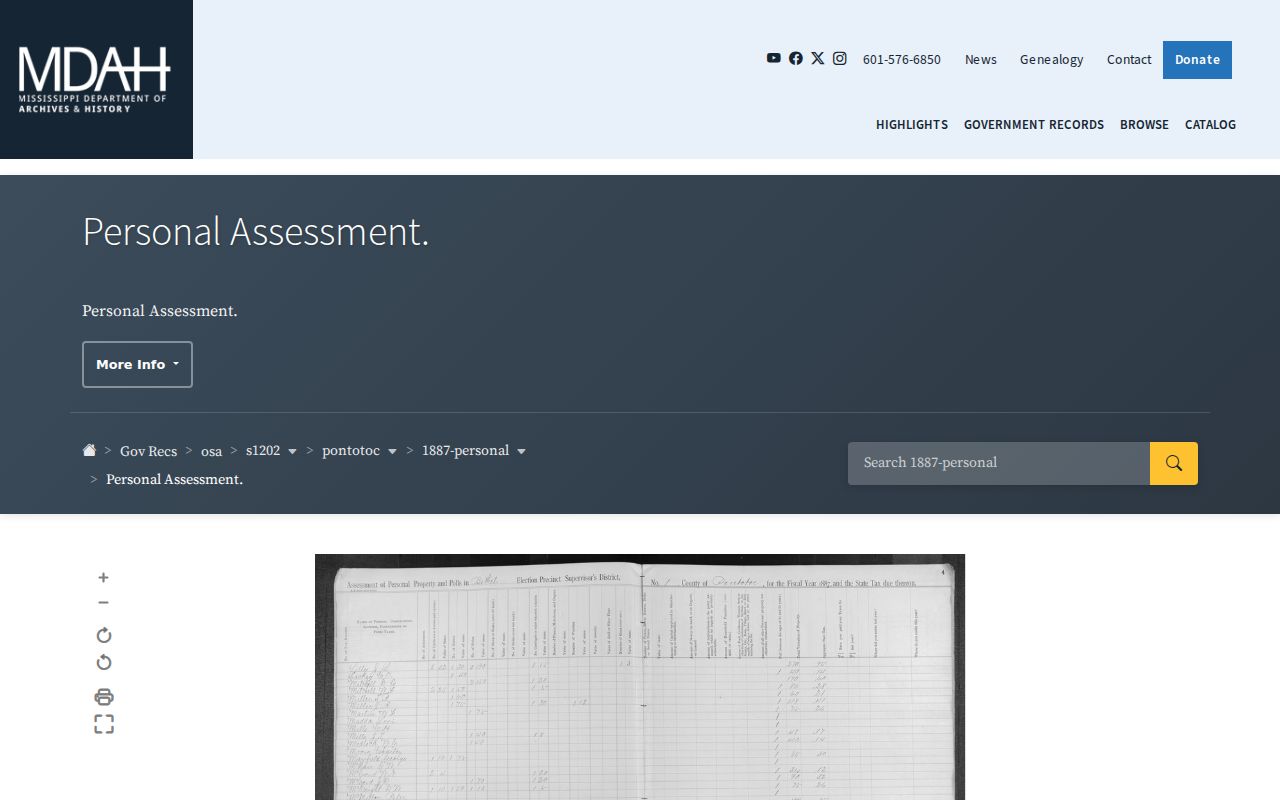
An old tax roll is an archival route, not a modern parcel match. Align person, year, land description, and series. MDAH's county finding aid spans 1836 through 1974. Access to originals, microfilm, and digital images varies by item.
A historical roll shows who was assessed and how property was categorized that year. It is not an ownership certificate. County boundaries matter too. Portions of Pontotoc County went to Lee County in 1866 and Union County in 1870. A place labeled Pontotoc in an early record may need a second jurisdiction search today.
For an archival request, supply the record series, box or item, tax year, person or entity, and legal geography. Precision beats a surname sweep. It also helps the archives tell an original county record from courthouse microfilm or a digitized image.
Contest a Pontotoc County Assessment
Owners appeal locally. The route runs through the Pontotoc County Board of Supervisors. The current assessment notice controls the deadline. DOR guidance places it near the first Monday in August before the tax year. Evidence should include the parcel card, measurements, photographs, class information, comparable evidence, and any factual correction, and the DOR appeal page distinguishes county review from separate state administrative appeals.
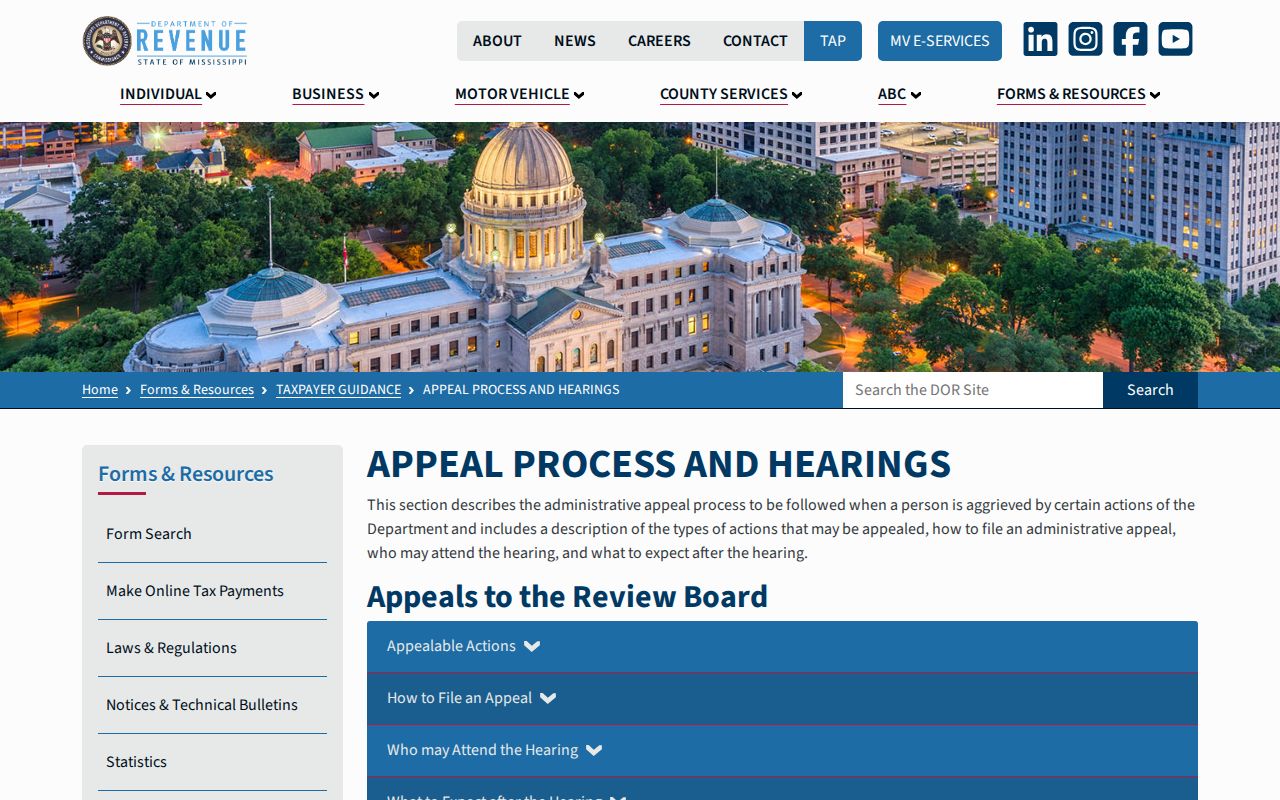
Timing depends on which assessment is challenged. Follow the local notice. A deadline lifted from an unrelated DOR assessment will mislead.
Separate factual errors from valuation disputes. Wrong acreage, classification, ownership date, or parcel description calls for the source record. That record proves the correction. A value argument needs evidence tied to a comparable date, property class, condition, and location. Keep copies of the notice, the submission, and any county response. That paper trail preserves the procedural history.
The assessor and the Board of Supervisors are the local route. State material explains the framework. It cannot replace Pontotoc County's notice or file a county appeal. If a record is missing, ask which office holds it. Ask whether it can be inspected in person. Otherwise it may be supplied electronically or by mail.
After a decision, keep the county's written response and the roll version it addresses. A later revaluation, classification change, exemption update, or corrected parcel fact can produce a different figure. That does not prove the appeal was mishandled. Compare records from the same tax year. State exactly which value is under review. Retain the PPIN, PARID, classification, assessed value, notice date, and source. A later roll update then cannot be mistaken for the figure actually contested.
Appeal window. Confirm the date printed on the current notice and contact the county promptly; missing the local window may defer review.